Residential construction
Types of Balcony: Choosing the Right Outdoor Extension

Introduction
Balconies extend living spaces beyond the building envelope, offering light, ventilation, and a connection to the outdoors. While they may look similar at first glance, different balcony types serve very different functional and structural purposes.
Understanding these distinctions helps designers and homeowners make informed decisions that balance aesthetics, safety, and usable space.
Common Balcony Types
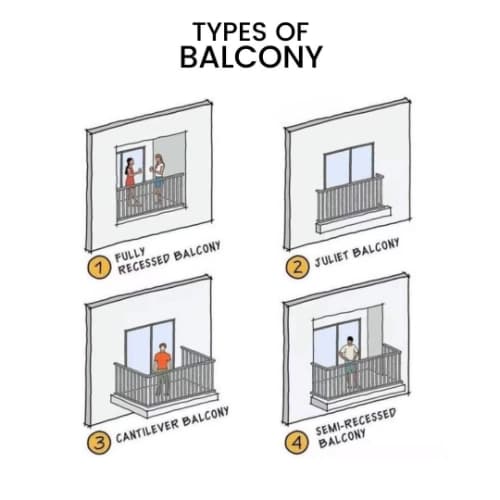
Fully recessed balconies sit entirely within the building mass, providing privacy and natural shading while reducing exposure to wind and rain. They are often favored in dense urban settings.
Juliet balconies are shallow or non accessible platforms placed in front of full height doors. While they do not provide usable floor space, they improve daylight, ventilation, and façade articulation.
Projected and Hybrid Designs
Cantilever balconies project outward from the building structure, creating clear usable outdoor space and strong visual presence. These designs require careful structural detailing to manage loads and deflection.
Semi recessed balconies combine both approaches, offering partial enclosure with some projection. This hybrid option balances openness with protection from the elements.
The Bottom Line
Each balcony type comes with trade offs related to space, structure, cost, and comfort. There is no universally correct choice, only the option that best fits the building’s context and the user’s needs.
Thoughtful selection and detailing ensure balconies enhance both the experience of the space and the overall architectural composition.