Structural & civil
Understanding I-Beams: A Civil Engineer’s Guide for Clients
Introduction
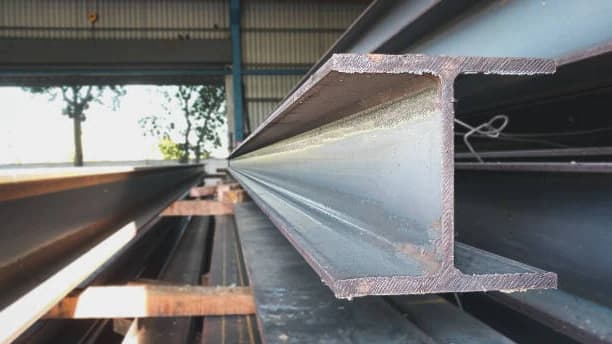
As a civil engineer, one of the most common structural elements I specify in building and infrastructure design is the I-beam—also known as a universal beam (UB), H-beam, W-beam, or rolled steel joist (RSJ). Recognizable by its capital “I” shape, this beam is a powerhouse in supporting loads efficiently and safely.
I-Beam vs H-Beam: Key Differences
At first look, both I-beam and H-beam look similar, but there are some basic different points between them:
- H-beam is also called wide flange
- H-beam is often heavier than I-beam
- H-beam has a thicker web as compared to I-beam
- Top and bottom flanges of H-beam are longer and thicker than I-beam flanges
- H-beam is stronger and can take a heavier load than I-beam
- A single H-beam can cover a greater distance/span than an I-beam
What Makes an I-Beam So Strong?
The secret lies in its geometry. An I-beam consists of:
- Flanges: The top and bottom horizontal plates that handle compression and tension forces. Flanges are far from the neutral axis, so they take the bending moment (lever arm distance).
- Web: The vertical plate that resists shear forces. Web is near the neutral axis, so it carries the shear force.
This design places material where it is structurally needed most. As a result, I-beams deliver high strength with minimal weight, which optimizes both performance and cost. In an I-beam, strength comes from teamwork — flanges fight bending, web holds shear.
Where Are I-Beams Used?
You can find them in nearly every major structure, such as:
- Commercial buildings and bridges
- Industrial facilities
- Residential houses (floor beams and roof supports)
- Highway overpasses
- Tower structures and platforms
Any application requiring long spans and high load-carrying capacity may utilize I-beams.
Steel Grades and Sizes
I-beams come in a variety of sizes and steel grades depending on design requirements. Engineers select the right beam based on:
- Span length
- Type and magnitude of loads
- Deflection limits (how much the beam can safely bend)
- Environmental conditions such as corrosion risk
We use global standards like ASTM, EN, or JIS depending on the project location.
Installing and Connecting I-Beams
I-beams are connected through:
- Bolted connections (common in steel frames)
- Welded joints (used for rigid, permanent connections)
Proper installation is crucial to maintain structural integrity. Field alignment, lifting safety, and inspection of welds and bolts are all necessary steps.
Why Clients Should Value Structural Steel
Using I-beams provides several advantages:
- High strength-to-weight ratio
- Design adaptability and speed of construction
- Durability and recyclability
- Cost-effective long-term performance
Steel structures can also be expanded or modified in the future—something concrete often cannot do as easily.